Why Choose Us?

Join more than 100,000 women who choose BayCare for their breast health needs every year. With over 20 breast imaging centers and two Comprehensive Breast Care Centers, you have access to expert care close to home. Many of our breast imaging centers are accredited by the American College of Radiology for mammography, reflecting our commitment to high-quality imaging. Our services include routine screenings, advanced imaging and specialized cancer treatment. Whichever stage of the journey you’re on, our experienced team can help you understand your options and support you every step of the way.


Advanced Screening and Treatment Options

Managing Your Breast Health

Managing Your Breast Health

While there’s no way to prevent breast cancer, healthy lifestyle choices may help lower your risk. Maintaining a healthy weight, exercising, limiting alcohol, carefully considering birth control and hormone therapy options and breastfeeding, when possible, may help lower your risk. Factors such as gender, age, family history and genetics can influence your risk and can't be changed. By understanding your personal risk factors and staying up to date with recommended breast screenings, you can take an active role in supporting your breast health.

The Latest Breast Screening Technology

Our hospital-based breast centers and outpatient imaging centers use 3-D mammography (breast tomosynthesis) to examine breast tissue layer by layer. In under five seconds, our advanced technology generates high-resolution 3-D images, improving breast tissue visibility and cancer detection. Designed with your comfort in mind, our system uses a curved design to distribute pressure more evenly and minimize pinching, for a comfortable, faster and more accurate exam. Breast density assessment tools also provide information about your breast cancer risk and help reduce unnecessary callbacks and follow-up testing.

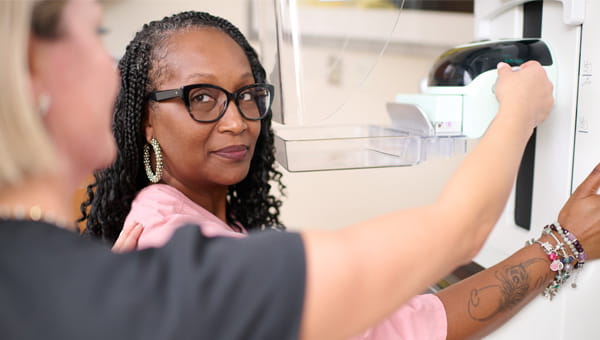
Lady working with a nurse during a mammogram.
BayCare’s Comprehensive Breast Care Center[s

BayCare’s Comprehensive Breast Care Centers

Designed around your unique needs, BayCare’s Comprehensive Breast Care Centers provide an integrated approach that connects your health care team from diagnosis through survivorship. You’ll also have access to advanced treatment options and national clinical research trials along with support from a dedicated nurse navigator who guides you throughout your care journey. Our breast programs are accredited by the Commission on Cancer and the National Accreditation Program for Breast Centers, demonstrating our commitment to providing high-quality breast care.

Frequently Asked Questions

  • What should I look for during a breast self-exam?

    Early detection starts with knowing your body. While screening mammograms are an important part of your breast health, being aware of any changes in your breasts can help identify potential concerns sooner. Contact your health care provider if you notice:

    • A lump in the underarm area, in or on the breast
    • Swelling of all or part of the breast; feels hard, warm or tender
    • Unexplained shrinkage of one or both breasts
    • Change in breast color
    • Skin irritation, itching or dimpling
    • Breast pain
    • Nipple pain, change in appearance or the nipple turning inward
    • Redness, scaliness or thickening of the nipple or breast skin
    • A nipple discharge other than breast milk
  • When should I get a mammogram?
    Women with average breast cancer risk should begin regular screening mammograms at age 40 and continue through age 74. Regular screening can help detect breast cancer early, when it’s most treatable. More than 96 percent of women with breast cancer are cured when it’s caught and treated early. If you have a family history of breast cancer, your doctor may advise you to start getting mammograms before age 40. Your doctor can help you decide when to begin breast screening based on your personal risk factors.
  • Should I schedule a screening mammogram or a diagnostic mammogram?
    You should schedule a screening mammogram if you:
    • Don’t have any symptoms
    • Are between the ages of 40 and 74 and scheduling your annual mammogram

    You should schedule a diagnostic mammogram if you:
    • Have an area of concern in your breast
    • Have pain in a specific area of your breast
    • Have unexpected nipple discharge
    • Have had an abnormal screening mammogram
    • Were told by your doctor to get a diagnostic mammogram

    Diagnostic mammograms are NOT for:
    • Dense breast tissue
    • Fibrocystic breasts
    • General pain
     
  • What should I expect during my mammogram?

    How to prepare for your mammogram

    On the day of your exam, avoid using perfume, lotion, powder or deodorant from the waist up, as these products can affect image clarity. When you arrive, you’ll be guided to a private changing area where you’ll undress from the waist up and you’ll change into a soft robe that opens in the front.

    What will happen during your exam

    In the exam room, your technologist will take four images of each breast individually from multiple angles. The technologist will gently position your breast on a platform with brief compression to capture clear details. You’ll need to hold still for a few seconds at a time. You may feel mild pressure, but the scan happens quickly, often in less than five seconds. 

    Results and next steps after your mammogram

    For a screening mammogram, your results will be ready within 48 hours. If the radiologist sees an area requiring a closer look, you may need to schedule follow-up diagnostic imaging, such as a targeted scan, ultrasound or biopsy. Your care team will guide you through the next steps. If you’re having a diagnostic mammogram, a radiologist will review your results immediately.