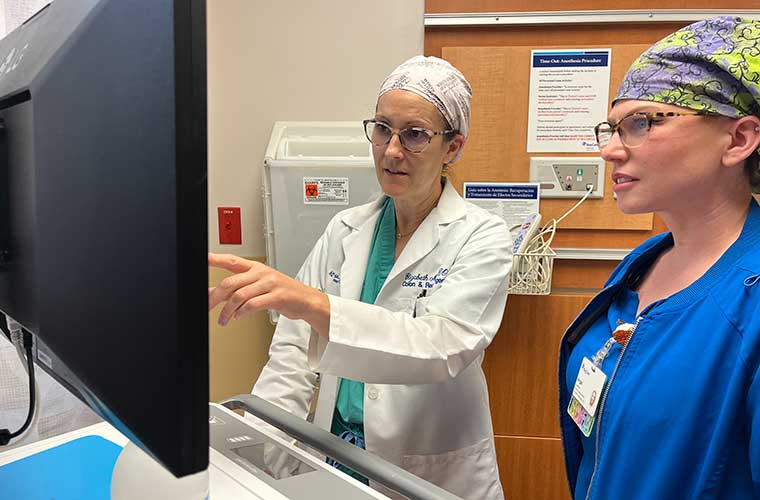
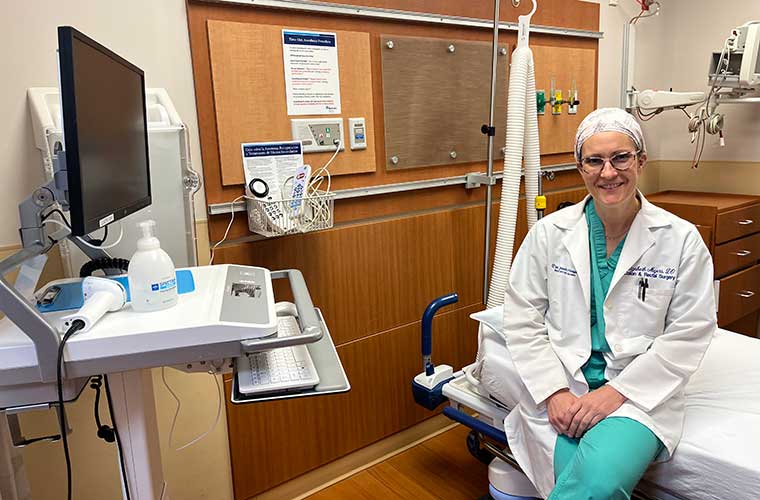
Dr. Elizabeth Myers is usually the one delivering diagnoses to her patients. A recent health experience, however, reminded her firsthand about the importance of knowing your risk and getting an annual mammogram.
As a colorectal surgeon with BayCare's St. Joseph's Hospital, Elizabeth Myers, DO, regularly encourages patients to stay up to date on recommended cancer screenings. Last year, she received a reminder of why those screenings matter when a routine mammogram led to additional testing.
Following an abnormal result, Dr. Myers worked closely with her physician and received treatment at St. Joseph’s Hospital and the Hinks and Elaine Shimberg Breast Center at St. Joseph’s Women’s Hospital.
Although cancer was not found, Dr. Myers is sharing her story during Breast Cancer Awareness Month to encourage others to learn about their family history, understand their risk and prioritize annual mammograms.
Describe your family history of breast cancer.
I started mammograms at age 35 given my family history. (The age recommended by the American College of Radiology for a routine screening mammogram is 40 for those at average risk). My maternal grandmother had breast cancer in her 80s. My maternal aunt had ductal carcinoma in situ (DCIS is a type of cancer in which abnormal cells are contained inside the milk ducts and have not broken through the duct walls). She required a mastectomy and radiation at around age 50. My father had a locally advanced prostate cancer at age 47, which can be linked to the BRCA (Breast Cancer) gene.
Because of your family history, was it always in your mind that you could develop breast cancer?
I know my family history puts me at higher risk for breast cancer but it has not been at the forefront of my mind that I might develop it. I am used to being the physician who tells other people about their risks and their diagnosis.
When your mammogram came back abnormal, what were your first thoughts?
I had abnormal calcifications and was worried I had DCIS like my aunt and I knew there could be a potential underlying cancer. I wasn't initially concerned but thoughts did start to creep into my head about the what ifs. Honestly, my biggest fear was that if I had cancer and needed chemotherapy, the side effects would cause me to develop neuropathy in my hands and limit my surgical career.
What type of treatment did you receive after your initial mammogram?
I then had a diagnostic mammogram. The radiologist read it and the cancer coordinator immediately took me into a consultation room (like I do with patients). I was told that I needed a stereotactic biopsy. It showed an abnormality that is a marker for a higher risk of future cancer in either breast. I had a breast MRI to be sure nothing else was detected in either breast. I then had a wide local excision to remove it and ensure there was no hidden cancer in this abnormal tissue. Thankfully, there was none. I will now need breast MRIs and mammograms annually for the rest of my life for close surveillance.
What was your down time after you received treatment?
I had outpatient surgery and my down time was minimal. I was back operating and taking care of other patients in a week.
Why is it so important to have an annual mammogram?
I would never have known I had an abnormality in my breast if I hadn't had a mammogram and I wouldn't know I need future close monitoring. Not all breast cancers or abnormal lesions can be palpated. Physicians tend to be the worst patients as we are always busy caring for everyone else.
While this was not cancer, it really was a wakeup call on how important mammogram screening is. There are three things I will never miss – a colonoscopy, a pap smear and a mammogram. These are cancers that are preventable or more easily treated when caught early. Treatment is much harder to endure than the 10 minutes it takes to have an annual mammogram.
Learn More:
High risk of breast or other cancers: BayCare High Risk Cancer Program
BayCare’s comprehensive cancer care: BayCare Cancer Institute