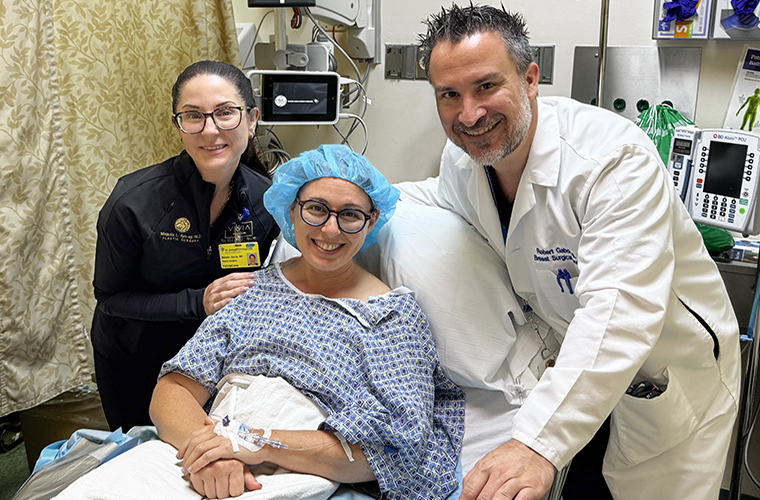
When BayCare introduced robotic-assisted nipple-sparing mastectomy earlier this year, the innovative procedure offered a new option for carefully selected patients diagnosed with breast cancer. As the program continues to grow, it is also helping women with a hereditary risk of the disease take a proactive approach to their health.
One of those patients is 39-year-old Arianna Sabghir, who carries the BRCA1 gene mutation and has a strong family history of breast and ovarian cancer. After years of considering preventive surgery, she decided it was time to move forward.
"I knew the surgery was something I needed to do eventually," Sabghir said. "I could either have a double mastectomy before developing breast cancer or wait until after a diagnosis and potentially face treatment and long-term effects. I wanted to be proactive."
For Dr. Robert Gabordi, BayCare Medical Group breast surgical oncologist and medical director of BayCare's St. Joseph's Hospitals breast surgery program, patients like Sabghir are among those who may benefit from the new procedure.
Determining the Right Candidate
Robotic-assisted nipple-sparing mastectomy allows surgeons to remove breast tissue through a small incision while preserving the nipple and surrounding skin. The procedure uses single-port robotic technology that provides surgeons with enhanced 3D visualization, greater precision and increased instrument dexterity during surgery.
Compared with traditional open mastectomy techniques, the robotic-assisted approach requires a smaller incision that can be placed in a less visible location and may help reduce scarring while supporting quality of life after surgery.
"When determining candidacy, we look at several factors, including a patient's anatomy and, for cancer patients, the size and location of the tumor," Gabordi said. "Our goal is to identify who can safely benefit from a nipple-sparing mastectomy."
Every patient is evaluated by a multidisciplinary team that includes radiology, breast surgery and plastic surgery specialists.
"As we've gained experience with the technology, we've learned that more patients may be candidates than we initially thought," Gabordi said.
In many cases, women who qualify for a traditional nipple-sparing mastectomy may also be candidates for a robotic-assisted approach.
Choosing Prevention
A recent breast MRI brought renewed urgency to a decision Sabghir had been considering for years. In September, she chose to move forward with a preventive double mastectomy rather than continue monitoring her elevated risk.
As a mother of five children, including two sons with Down syndrome who will require lifelong support, she wanted to address the issue while she was healthy and able to recover on her own terms.
"Right now, I have a job that allows me to take time off. Everybody is healthy. I'm young and strong," she said. "It was the best time for me to do this."
Looking Like Herself
While recovery from any mastectomy is significant, Sabghir said one of the most meaningful aspects of the procedure has been preserving her sense of self.
Having helped care for her mother after breast cancer surgery, she witnessed firsthand the emotional and physical challenges that can accompany reconstruction.
For eligible patients, preserving the nipple and surrounding skin can help maintain a more natural appearance after reconstruction.
"The fact that I can look in the mirror and think, 'That looks like me. I look like me,' is huge," Sabghir said. "I'm still healing, but I look like myself."
Expanding Options
Sabghir hopes sharing her story helps other women with a hereditary cancer risk understand the choices available to them.
"If this becomes her reality someday, I want my daughter to know she has options," she said. "She doesn't have to live her whole life feeling like she's waiting for something bad to happen."
For Gabordi, that's exactly the conversation he hopes to encourage.
"Every patient is different," he said. "The key is helping patients understand their risk and find a treatment plan that's right for their situation.”
For Sabghir, the surgery brought something years of monitoring never could: the peace of mind that comes from taking action on her own terms.
Learn more: BayCare's Comprehensive Breast Care Centers