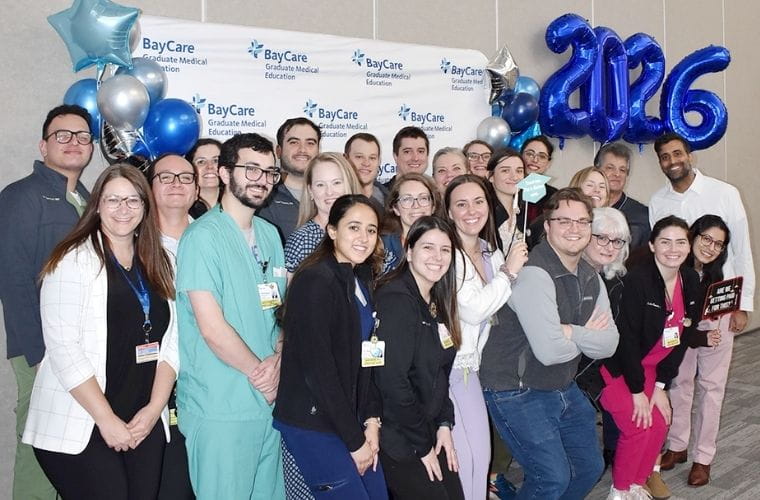
For the second year in a row, BayCare’s Graduate Medical Education program filled 100% of its open residency positions after completing a successful Match Day on March 20, nearly doubling the size of the program.
BayCare, the region’s largest academic health system and home to one of the fastest growing Graduate Medical Education programs in the nation, is creating a pipeline of future physicians to care for the region’s growing population. More physicians in the region will help improve patient access to quality care. This July, BayCare will welcome 194 new residents into its program, bringing the total number to more than 400.
“Achieving a 100% match speaks to the quality of BayCare’s Graduate Medical Education program,” said Chief Physician Executive Dr. Sowmya Viswanathan. “Prospective residents are drawn to the exceptional physicians who teach here and the depth and breadth of experience they will gain from working within West Central Florida’s largest integrated health system. On average, more than 60% of our program graduates who do not pursue further training stay with us and begin practicing in BayCare Medical Group clinics and hospitals.”
According to an Association of American Medical Colleges study, more than half of physicians who completed residency training over a 10-year period continued to practice in the state where they were trained. Notably, many of BayCare’s incoming residents are Floridians or have completed their medical education in the state. BayCare’s goal is to expand its Graduate Medical Education Program to more than 650 residents by 2029.
BayCare currently offers 14 residency programs, along with three university-sponsored programs, in emergency medicine, internal medicine, family medicine, general surgery, obstetrics and gynecology, pediatrics, psychiatry, and transitional year.
Each year, Match Day is organized by the National Resident Matching Program (NRMP) and the Association of American Medical Colleges (AAMC). These groups work together to pair fourth-year medical school students with residency programs based on mutual preference. Students rank their residency program preferences, and then residency programs review their applications to see if they are an ideal match.
For more information: BayCare’s Graduate Medical Education program