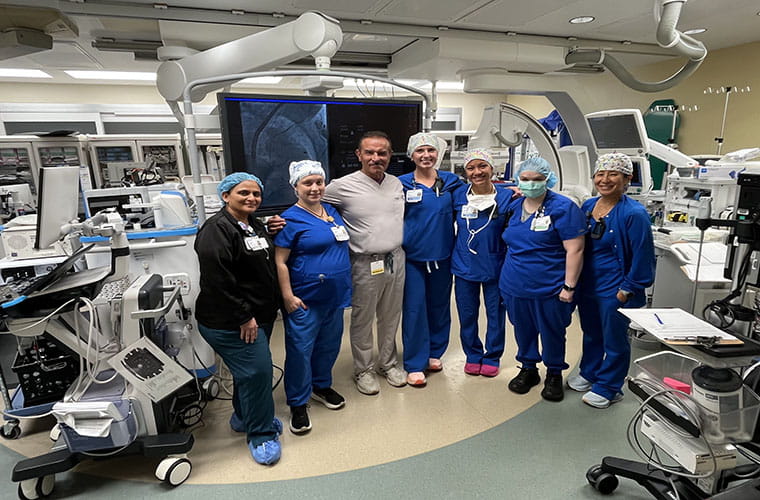
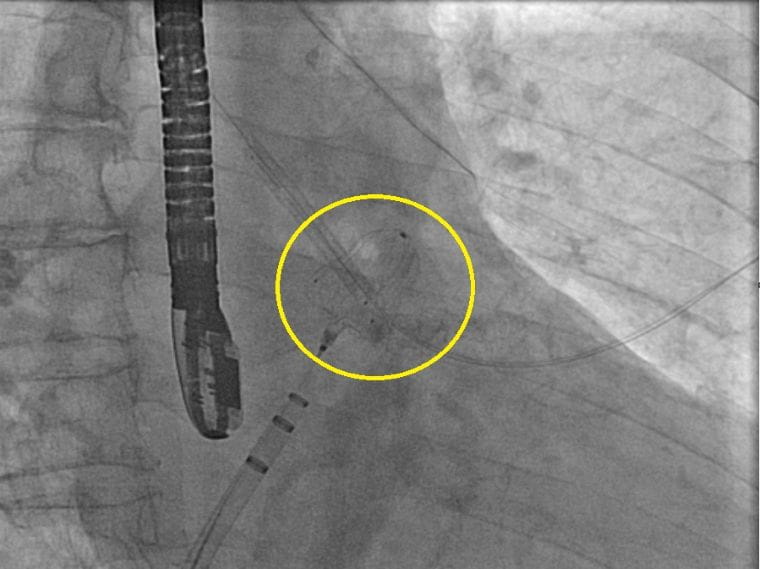
BayCare’s St. Joseph's Hospital-South in Riverview is now offering the Watchman™ procedure, a minimally invasive treatment that helps reduce stroke risk for some patients with atrial fibrillation (AFib) and may eliminate the need for long-term blood-thinning medication.
During the procedure, physicians place a small, permanent implant in the heart to close off the area where stroke-causing blood clots most often form.
St. Joseph's Hospital-South joins St. Joseph's Hospital in Tampa, Morton Plant Hospital in Clearwater and Winter Haven Hospital in Winter Haven in offering the technology.
AFib is a common heart rhythm disorder that causes the heart's upper chambers, called the atria, to beat irregularly instead of in a normal rhythm. Because blood no longer moves through the atria normally, it can pool and form clots — most often in a small pouch off the left atrium called the left atrial appendage. If a clot travels out of the heart to the brain, it can cause a stroke. People with AFib have a higher risk of stroke for this reason, which is why many take blood thinners to help prevent clots.
The Watchman device addresses that risk directly. About the size of a quarter, it is guided to the heart through a vein in the leg and placed at the opening of the left atrial appendage, sealing it closed so clots can no longer form there and escape into the bloodstream. Over the following weeks, the body's own tissue grows over the implant. Once healing is complete, many patients can stop taking long-term blood thinners under the guidance of their physician. This can be especially beneficial for people who cannot tolerate these medications or who are at higher risk of bleeding.
Dr. Rajesh Malik, director of electrophysiology services at St. Joseph's Hospital-South, performs the Watchman procedure and oversees the hospital's care for patients with abnormal heart rhythms. He noted that Watchman can be performed during the same procedure as an ablation for AFib. An ablation uses controlled energy to create small areas of scar tissue that block the faulty electrical signals causing the irregular rhythm — another alternative to lifelong medication. Ablations are already performed at St. Joseph's Hospital-South.
"We offer Watchman and ablation to be done right here at St. Joseph's Hospital-South at the same time," Dr. Malik said. "Patients don't have to go through two separate procedures."
Michelle Landy, St. Joseph's Hospital-South's operations director, said the ability for the Riverview hospital to perform both procedures benefits the local south Hillsborough County community.
"It's extremely important," she said. "We're honored to have a cardiologist with a lot of experience to perform it. Patients can stay local and don't have to travel far to a larger facility. It's a new service we're really proud of."
Learn more about
BayCare’s Heart and Vascular Institute and the advanced cardiac care available throughout West Central Florida.