Michael Warner, a seasoned triathlete from Sarasota, had just passed the first buoy in the swim portion of the St. Anthony's Triathlon Sprint event in April. He thought how the water was flat, the sun was up and it was a beautiful day. Those were his final memories of the race.
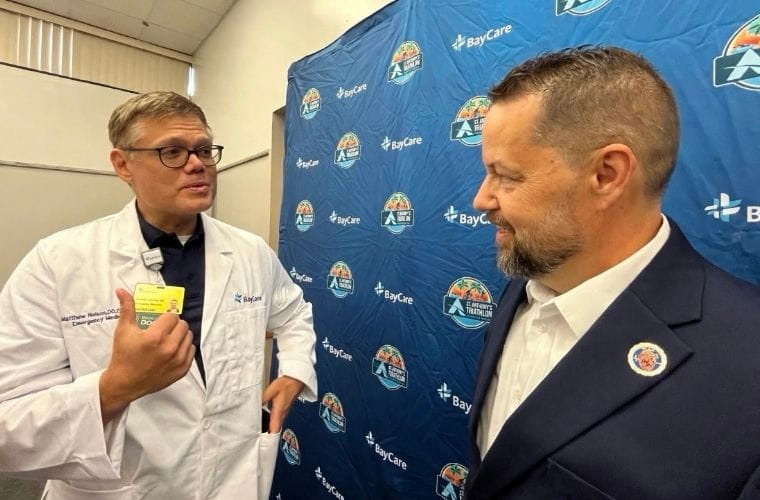
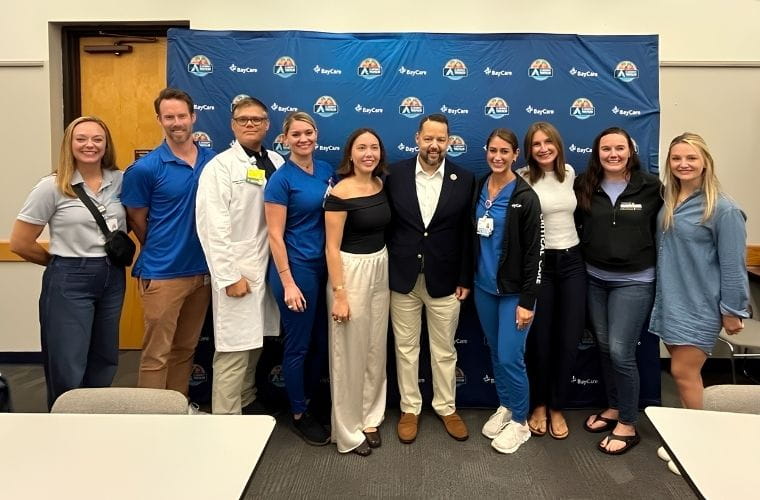
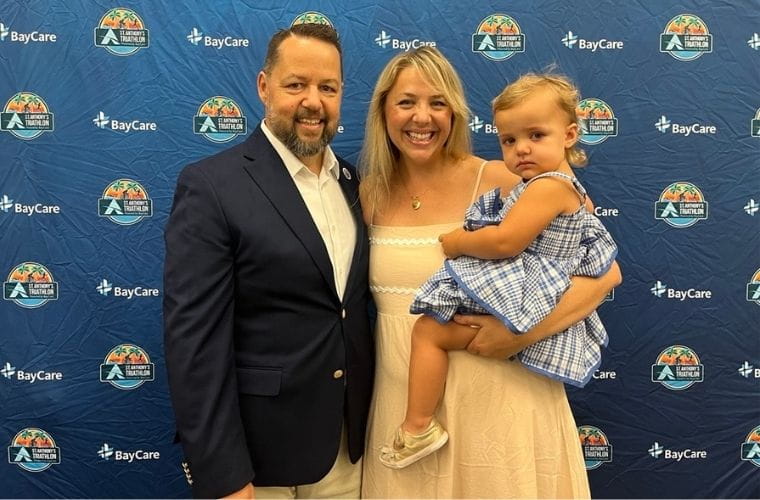
Four days later he awakened. He learned that it took the expertise of first responders and the teams at two BayCare hospitals – St. Anthony’s Hospital in St. Petersburg and St. Joseph's Hospital in Tampa – using emergency services and clinical excellence to provide advanced care after he suffered a heart attack. On Friday (Aug. 28), the day after his birthday, he and his family met BayCare team members and first responders at St. Petersburg Fire Rescue headquarters to thank them for saving his life.
“It sounds weird to say, but if you’re going to have a heart attack, the best place to do it is at the St. Anthony’s Triathlon,” Warner said. “They were so well prepared for everything.”
Patrick McGee, St. Anthony’s Triathlon manager and race director, said that preparation begins months before the event takes place through meetings with St. Petersburg Fire Rescue, the St. Petersburg Police Department water safety team and Emergency Medical Service transport units.
“All the agencies provide phenomenal services that are necessary to ensure a safe and successful Triathlon,” McGee said.
After Warner suffered the heart attack on April 26, he swallowed water, sand and shells that aspirated into his lungs. He was pulled from the water and rushed to the St. Anthony’s Hospital emergency room. He was told that his heart stopped three times.
"This patient was in critical condition,” said Matthew Nelson, DO, the Triathlon’s medical director. “Fortunately, EMS personnel were able to restore a pulse, but from that moment forward time was absolutely critical. Within minutes, we got him into the hands of an interventional cardiologist who identified and treated the blocked coronary artery. That rapid chain of care ultimately helped to save his life.”
As he was in the St. Anthony’s emergency room, Warner’s wife, Natalie Warner, received a call telling her to get to the hospital as quickly as possible. Once there, they let Natalie see him before he went into surgery. “When I spoke to him, he reacted and they told me to keep talking to him,” Natalie said. “After surgery, I thought everything was going to be okay. But that was just the beginning.”
Because of what he inhaled, Warner developed sepsis and pneumonia. Doctors determined he would benefit from advanced services at St. Joseph’s Hospital.
“It was truly the BayCare Effect,” Dr. Nelson said. “Our hospitals throughout the system are constantly working together to provide the best coordinated care to our patients.”
When Warner arrived at St. Joseph’s Hospital, his condition began to improve. A week after he suffered the heart attack, he was discharged.
“The nurses everywhere were just amazing,” Natalie said. “Considering the scenario, I just have positive things to say about both hospitals. Everyone was so accommodating.”
As they listened to what various first responders and BayCare team members did to help him, the Warners smiled, shed a few tears and thanked them all. “I was telling a friend (my) story and he said that everything went wrong,” Warner said. “But I said, just one thing went wrong – the heart attack – and a thousand things went amazingly right.”
Warner’s recovery reflects the strength of BayCare’s cardiovascular network, where emergency responders, physicians, nurses and specialty teams work together to provide advanced heart care when every second counts. From emergency intervention at St. Anthony’s Hospital to coordinated specialty care at St. Joseph’s Hospital, BayCare’s heart and vascular experts combine leading technology, clinical expertise and compassionate care to support patients throughout their recovery journey.
Learn more: BayCare Heart and Vascular Institute